


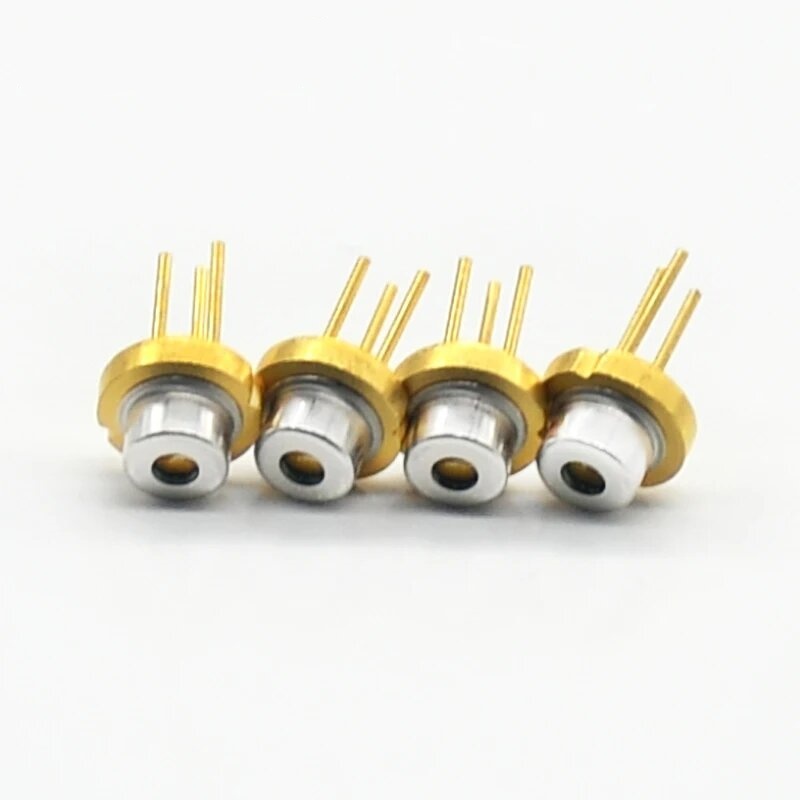

Multi-mode laser diodes: These have a broad active region that supports multiple optical modes, resulting in a wider beam with high divergence and low coherence. They have high output power and broad spectral width. They are used for applications that require high intensity and brightness, such as laser cutting, welding, printing, and illumination.
Master oscillator power amplifier (MOPA) laser diodes: These combine a single-mode laser diode as an oscillator with a multi-mode laser diode as an amplifier to increase the output power without compromising on the spectral width or coherence. They are used for applications that require high power and narrow spectrum, such as lidar, range finding, and medical imaging.
Vertical cavity surface emitting laser (VCSEL) diodes: These emit light perpendicular to the surface of the device, rather than parallel to it, as in conventional edge-emitting laser diodes. They have a short optical cavity with distributed Bragg reflectors (DBRs) at both ends to provide feedback. They have low threshold current, high efficiency, circular beam profile, and easy integration with other devices. They are used for applications such as optical interconnects, data communication, sensing, and optical mice.
Distributed feedback (DFB) laser diodes: These have a periodic structure embedded in the active region that acts as a grating to provide feedback and wavelength selection. They have narrow spectral width, high stability, low noise, and tunability. They are used for applications such as fiber optic communication, spectroscopy, and metrology.
External cavity diode lasers (ECDLs): These use an external optical component such as a grating or a prism to provide feedback and wavelength selection instead of an internal cavity. They have high tunability, narrow spectral width, low noise, and high coherence. They are used for applications such as spectroscopy, metrology, atomic physics, and quantum optics.
What are the Applications of Laser Diodes?
Laser diodes have a wide range of applications in various fields due to their advantages such as compact size, low power consumption, high efficiency, long lifetime, and versatility. Some of their applications are:
Optical storage: Laser diodes are used to read and write data on optical discs such as CDs, DVDs, and Blu-ray discs. They use different wavelengths of light to store different amounts of data on different layers of discs. For example, CDs use red laser diodes with 780 nm wavelength, DVDs use blue-violet laser diodes with 405 nm wavelength, and Blu-ray discs use blue laser diodes with 450 nm wavelength.
Optical communication: Laser diodes are used to transmit data over long distances using fiber optic cables. They modulate their intensity or frequency according to the data signal and send pulses of light through thin glass fibers that carry them with minimal loss or interference. They use different wavelengths of light to multiplex multiple channels of data on a single fiber, increasing its capacity. For example, fiber optic communication systems use infrared laser diodes with wavelengths ranging from 800 nm to 1600 nm.
Optical scanning: Laser diodes are used to scan barcodes, UPC codes, and other patterns using devices such as barcode readers, scanners, and printers. They emit a beam of light that reflects off the pattern onto a photodetector that converts it into an electrical signal. They use visible or near-infrared wavelengths of light depending on the type and color of the pattern. For example, barcode scanners use red laser diodes with 650 nm wavelength.
Optical sensing: Laser diodes are used to measure various physical parameters such as distance, speed, temperature, pressure, and concentration using devices such as lidar, radar, thermometers, pressure sensors, and gas analyzers. They emit a beam of light that interacts with the target object or medium and returns back to a detector that analyzes its properties. They use different wavelengths of light depending on the type and range of measurement. For example, lidar systems use near-infrared laser diodes with 905 nm or 1550 nm wavelength.
Optical display: Laser diodes are used to project images or information onto screens or surfaces using devices such as projectors, TVs, monitors, and holograms. They emit beams of red, green, and blue light that combine to form different colors and shapes according to the input signal. They use visible wavelengths of light depending on the resolution and brightness of the display. For example, laser projectors use red laser diodes with 635 nm wavelength, green laser diodes with 520 nm wavelength, and blue laser diodes with 445 nm wavelength.
Optical surgery: Laser diodes are used to perform various medical procedures such as cutting, cauterizing, ablation, coagulation, and photocoagulation using devices such as surgical lasers and endoscopes. They emit beams of light that penetrate the tissue and cause thermal or photochemical effects depending on the power and duration of exposure. They use different wavelengths of light depending on the type and depth of treatment. For example, ophthalmic lasers use green laser diodes with 532 nm wavelength to treat retina and macular diseases.
Advantages of Laser Diodes
Laser diodes have several advantages over other types of lasers, such as:
Compact size: Laser diodes are very small and lightweight, making them easy to integrate with other devices and systems.
Low power consumption: Laser diodes require low voltage and current to operate, reducing energy cost and heat generation.
High efficiency: Laser diodes convert a large fraction of the electrical input into optical output, resulting in high brightness and intensity.
Long lifetime: Laser diodes have a long operational life, lasting for thousands of hours without degradation or failure.
Versatility: Laser diodes can produce light in various wavelengths, modes, and patterns, allowing for a wide range of applications and customization.
Disadvantages of Laser Diodes
Laser diodes also have some disadvantages, such as:
Temperature sensitivity: Laser diodes are sensitive to temperature changes, which can affect their performance and reliability. They may require cooling systems or temperature controllers to maintain optimal conditions.
Optical Feedback: Laser diodes are prone to optical feedback that can destabilize, create noise, or damage the device, often requiring isolators or filters to block unwanted reflections.
Mode hopping: Laser diodes may exhibit mode hopping, which is a sudden change in the output wavelength or mode due to fluctuations in temperature, current, or optical feedback. This can affect the coherence and stability of the output beam.
Cost: Laser diodes can be expensive, especially for high-power or tunable devices. They may also require additional components or circuits to drive and control them.
Summary
A laser diode is a semiconductor device that produces coherent light through a process of stimulated emission. It is similar to a light-emitting diode (LED), but it has a more complex structure and faster response time.
A laser diode consists of a p-n junction with an additional intrinsic layer in between, forming a p-i-n structure. The intrinsic layer is the active region where the light is generated by the recombination of electrons and holes.
A laser diode works by applying a forward bias voltage across the p-n junction, which causes current to flow through the device. The current injects electrons from the n-type region and holes from the p-type region into the intrinsic layer, where they recombine and release energy in the form of photons.
Some of these photons are spontaneously emitted in random directions, while others are stimulated by existing photons in the cavity to emit in phase with them. The stimulated photons bounce back and forth between the reflective ends, causing more stimulated emission and creating a population inversion, where there are more excited electrons than non-excited ones.
When the population inversion reaches a threshold level, steady-state laser output is achieved, where the rate of stimulated emission equals the rate of photon loss due to transmission or absorption. The output power of the laser diode depends on the input current and the efficiency of the device.
The wavelength of the laser light depends on the band gap of the semiconductor material and the length of the optical cavity. Laser diodes can produce light in different regions of the electromagnetic spectrum, from infrared to ultraviolet.
Laser diodes are classified into different types based on their structure, mode of operation, wavelength, output power, and application. Some of the common types are single-mode laser diodes, multi-mode laser diodes, master oscillator power amplifier (MOPA) laser diodes, vertical cavity surface emitting laser (VCSEL) diodes, distributed feedback (DFB) laser diodes, external cavity diode lasers (ECDLs), etc.
Laser diodes have a wide range of applications in various fields due to their advantages such as compact size, low power consumption, high efficiency, long lifetime, and versatility. Some of their applications are optical storage, optical communication, optical scanning, optical sensing, optical display, and optical surgery.
Despite their benefits, laser diodes have drawbacks including temperature sensitivity, optical feedback, mode hopping, and high costs.
BU-LASER offers semiconductor laser diodes with TO can package from 375nm to 980nm, and we also offer professional OEM& ODM service of the laser diode modules for different applications. If you are interested in the laser diodes and laser diode modules, please contact our sales person at song@bu-laser.com.