

Views: 96 Author: Site Editor Publish Time: 2025-11-05 Origin: Site


We all may have played with laser light in our childhood for entertainment purposes and sometimes disturbing others. But that’s not it all. Lasers in today’s time are revolutionary technology in every field, whether it is medicine, defence, communication or even in science and technology. Lasers are a key component of large numbers of the items that we utilise today. Lasers are categorised into five main types based on their gain medium, which determines the type of laser needed for different applications. These include Solid-state laser, Liquid-state laser, Gaseous-state laser, Semiconductor laser and Metal Vapour laser.
LASER is an acronym for Light Amplification by stimulated emission of radiation. It is a device that emits light (basically electromagnetic radiation) through the process of stimulated emission.
Properties of Light:
The light is nearly monochromatic (single colour) in nature.
The light is usually coherent with the waves, all exactly in phase with one another.
These beams hardly diverge at all.
These beams are extremely intense far more than the light from any other sources.
Lasers are basically classified into 5 types based on their active medium. They are
Liquid-state laser
Gaseous-state laser
Solid-state laser
Metal Vapour laser
We will discuss some of these types in the upcoming parts of this article.
A semiconductor laser is usually referred to as a laser diode since it works similar to a diode with current flowing in the forward direction of the junction.
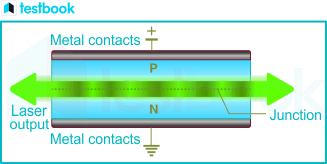
By injecting charge carriers into the region of space as characterized by the junction, recombination radiation can happen. Given this current infusion is sufficient, a population inversion can also be accomplished and stimulated emission will happen.
Because of these characteristics, they are one of the main classes of lasers being used today. They are utilized not only in applications like optical data storage and optical fibre communication, but also act as a pumping source for solid-state lasers.
The dimensions are very small and the arrangement is simple and compact.
It is found in various applications because of its high efficiency.
The Laser output can easily be controlled by just controlling the junction output.
It can even be operated on lesser power than other lasers and also require very little auxiliary equipment.
It is very hard to control the mode pattern and mode framework of the laser.
Its threshold current density is comparatively very high than other lasers.
The major issues with these types of lasers are their poor coherence and poor stability.
It is broadly utilized in fibre optic communication.
It is used to heal injuries by infrared radiation.
Semiconductor Lasers are even used for medicinal purposes as a painkiller
It is also used in the printing industry in laser printers and CD reading and writing.

A solid-state laser is one that utilizes a crystal, whose atoms are rigidly bonded, in contrast to a gas. The crystal produces laser light after a large amount of light is pumped into it by either a lamp or some other laser source. Since the laser light goes in a similar course as an intense beam, the laser creates an extremely brilliant light. It is exceptionally intensified and it might actually hurt humans.
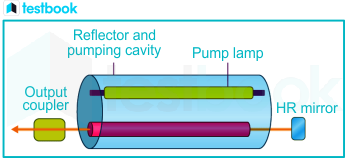
A solid-state laser uses a doped solid gain medium that, when excited, releases photons with the same wavelength. Mirrors trap the photons to stimulate more emission, producing amplification and eventually a coherent laser beam through an output mirror.
Solid-state laser casting is comparatively simple than other types of laser and also are pocket friendly.
Solid-state lasers are capable of producing both continuous and pulsed output.
Wastage of materials is very lower than the gaseous-state lasers.
Efficiency is comparatively lower than Carbon dioxide lasers.
Output voltage of the solid-state laser is not very impressive.
There is power loss due to thermal lashing in solid-state lasers.
These are usually used when drilling holes in metal sheets or slabs.
It can even be used for military purposes in the target destination system.
It can also be used in medical applications like endoscopy, etc.
A liquid laser, as the name suggests, involves the liquid as a laser medium. In liquid lasers, light acts as a supplier of energy to the laser medium.
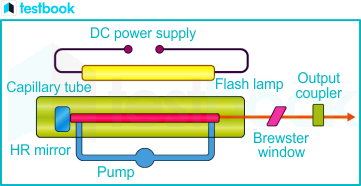
A dye laser is an illustration of a liquid laser. A dye laser is a laser that utilizes an organic dye (a liquid solution) as the laser medium. These lasers produce laser light from the excited energy conditions of organic dyes disintegrated or dissolved in liquid solvents. It produces laser light beams in the near-ultraviolet to near-infrared region of the spectrum.
These are capable of generating higher output power along with higher efficiency of 25%.
The beam divergence of liquid lasers is very low.
It can even be found in visible form.
The major drawback is its complex chemical composition because of that the cost is also very high.
These types of lasers are basically used as a research tool for medical purposes
A gas laser is a laser wherein an electric flow is released through a gas inside the laser medium to deliver laser light. In case of gas lasers, the laser media is itself in the gaseous state.
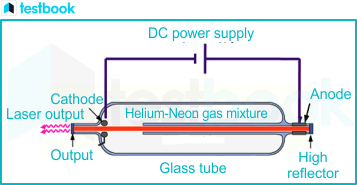
These have stable Central wavelength along with high spectral purity.
It has good beam quality along with better alignment than other types of lasers.
Because of the minute size of gaseous atoms these tend to diffuse with the atoms of walls of the gas tube.
These are used to make holograms and also used to read barcodes.
These are used as a source for writing on photosensitive materials.
Metal vapour lasers are a sort of gas laser which uses a metal vapour as a laser gain medium. More explicitly, the laser-active agents are metal atoms, or in some cases metal ions. Accessible emission frequencies of metal vapour lasers range from infrared to ultraviolet. The metal vapour is in many cases contained by a quartz tube, having cathodes, laser mirrors and optical windows at its closures.
A metal vapour laser uses metal atoms in a gaseous or plasma state as the gain medium. Electrical excitation of the metal vapour produces photons that stimulate further emission and amplification when trapped by mirrors, resulting in a coherent metal vapour laser beam. The key aspect is the use of vaporized metal atoms as the active gain medium.
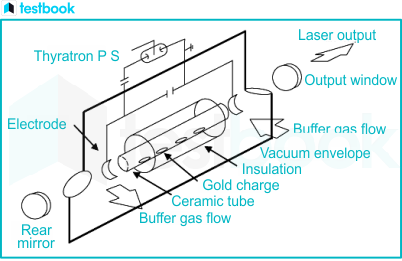
The major strength of these lasers are their capabilities to offer desirable wavelengths because of which these have been developed to commercial status.
These are one of the most reliable and robust commercial products in the industry.
The manufacturing technology of these types of lasers used to be difficult, primarily because of the requirements of high temperature at which these laser tubes operate which is around 1500°C.
Metal Vapour Lasers are usually used for pumping pulsed dye lasers or amplifiers and titanium sapphire lasers.
These are also sometimes used in photodynamic therapy.
Laser light is not quite the same as conventional light. It has different remarkable properties like coherence, monochromaticity, directionality, and extreme focus. Because of these special properties, nowadays lasers are utilized in different applications.
Consistently, the utilization of lasers for military purposes keeps on developing. Numerous armies from various nations utilize various sorts of laser frameworks for their particular battle tasks and activities. Traditional troops of land powers, cannons, air protection, and flying powers today perceive the laser as a significant functional component in expanding the accuracy and effectiveness of battle tasks. Lasers are additionally important for different training sessions in the instructive course of military servicemen in military schools and colleges as well.
There are various modern applications that could benefit from the utilization of a laser, which is found in numerous industries. Industrial lasers are utilized to cut metals and textures, mark tracking codes for modern traceability, weld metals with high accuracy, clean metal surfaces, change the surface harshness, and measure part dimensions. They are broadly utilised in several industries. For example, the EV and primary metals industries. Modern lasers are upgraded utilizing more elaborate techniques to build their power, accuracy, and vigor or robustness, however the principle remains the same.
Lasers are now an inseparable part of science and technology. From studying the research mechanism like Brownian motion to three-dimensional printing in space without the use of lenses, lasers are used everywhere. Some more applications are as follows: It helps in determining the rate of rotational motion of the Earth, detecting earthquakes and finding nuclear blast underwater. It is also useful for storing large amounts of data on CD Drives and also to retrieve them.
Laser was first introduced in medical sciences in 1961. Nowadays, lasers are in great demand in medical industry because of their high precision and less chances of infection. It also helps surgeons to perform complex operations and even reduces blood losses. Medical lasers are used for different clinical procedures including dermatology and plastic surgeries, injuries healings, nerve stimulation, dentistry, and cancer therapy. Diode lasers have been generally utilized in numerous surgeries including soft tissue cutting, coagulation and cancer thermal therapy. Different photosensitizers are introduced in matching the laser assimilation frequencies.
Optical communication has been one of the major driving thrusts in developing laser diode technology. Today, diode lasers are vital parts of any broadband communication framework. They are utilized as rapid transmitters in advanced and simple fibre optic organizations. They are also used to pump lasers in Erbium doped amplifiers or EDFAs, or as high-power pulsed lasers in tests and measurement sectors. Laser communications frameworks are wireless connections through the atmosphere. Light speed is believed to be the fastest speed that anything can travel. So, laser communications and laser sensing are significant in mortar defense and other pivotal aerospace applications.
BU-LASER provides Semiconductor diode lasers with violet, cyan, blue, green, red and infrared color (375nm- 1064nm, 1mW-500W output power, different beam mode, and dimensions) to better meet customers’ needs of different applications. We also offer professional OEM &ODM service! To know more, please get in touch with us at song@bu-laser.com.


