

Views: 0 Author: Site Editor Publish Time: 2026-01-29 Origin: Site


Lasers are used in 3D scanning by projecting light onto an object and measuring the reflection to calculate distance, creating a detailed "point cloud" of millions of data points that form a 3D model. Scanners use methods like Time-of-Flight (ToF), measuring the time for pulses to return, or Laser Triangulation, using angles and known sensor positions to determine depth. This process captures precise geometric data for applications in architecture, engineering, gaming, and manufacturing.

The scanner emits rapid laser pulses.
It measures the exact time it takes for each pulse to bounce back.
Knowing the constant speed of light, it calculates the distance to the object's surface.
Millions of these distance measurements create a dense point cloud.
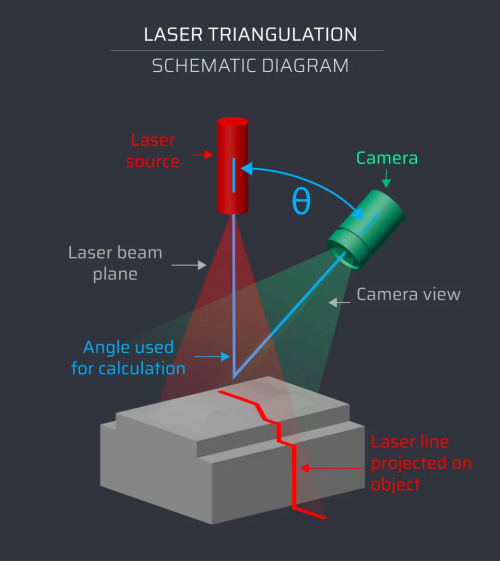
A laser line (or single point) is projected onto the object.
A camera, positioned at a known angle to the laser, captures the reflected laser line.
Using trigonometry, the system calculates the distance based on the angle of the reflected light and the fixed distance between the laser and camera.
Data Capture: Scanners move around the object or site, capturing data from multiple viewpoints.
Point Cloud Generation: All the calculated points (X, Y, Z coordinates) form a vast "point cloud".
3D Model Creation: Software processes the point cloud, merging it into a unified, detailed 3D mesh or model.
Color & Texture: High-resolution cameras often capture color and texture, adding realism to the digital model.
Architecture & Construction: As-built documentation, renovation planning, facility management.
Manufacturing: Quality inspection, reverse engineering, creating CAD models from physical parts.
Gaming & VR: Building realistic digital environments from real-world locations.

1. Single straight line laser module
2. Single-channel laser module to project Grid/ Structured dot matrix (use focus lens +DOE).
3. Single-channel laser module to project a multi-line pattern with a DOE (use focus lens +DOE).
4. Single-Channel laser module to project parallel multi-line laser beams ( use Powell line lens +DOE).
5. Multi-Channel laser module to project intersecting and parallel multi-line laser beams ( use Powell line lens +DOE). For current standard module, the customer can select to made it with one line, 3 lines, 7 lines, 13 lines, 21 lines, 25 lines, 49 lines.
All the above lasers can be customized with wavelength 375-980nm, different power, housing size, and so on. To know more, please get in touch with us at song@bu-laser.com.


