

Views: 0 Author: Site Editor Publish Time: 2026-01-20 Origin: Site


Simply put, laser 3D scanning is a process of capturing precise 3D information off any object or environment using a laser as a light source. The technology relies on laser beams to measure the distance to a surface and create ultra-realistic 3D models of objects, sites, and vast landscapes. 3D laser scanning is a popular engineering, construction, and architectural tool, commonly used to document and assess the condition of different structures.
3D laser scanners use LiDAR (light detection and ranging) by projecting laser light onto an object to record and measure precise locations and distances. Producing a point cloud file, scanners provide digital data invaluable in countless applications, from reverse engineering and quality inspection to heritage preservation and forensics. What makes the technology even more popular is that modern laser scanners are portable, safe, easy to use, and accurate down to millimeters.
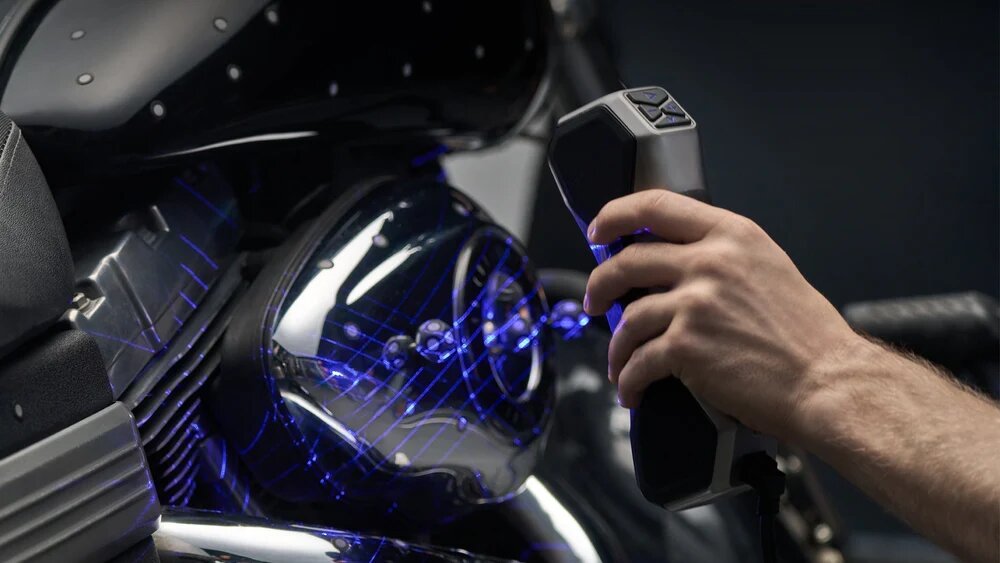
The way a laser scanner works boils down to beaming out light pulses at high speeds, which reflect off objects and return to the scanner’s sensor (LiDAR). For each pulse, the distance between the scanner and the object is measured by calculating the elapsed time between sent and received pulses. Each data point is converted to a pixel with known x, y, and z coordinates.
1.Laser emission: The scanner projects laser beams onto an object, typically in the form of rapid, short pulses in the infrared spectrum, which is invisible to the human eye.
2.Pulse reflection: When laser pulses hit the object, they bounce back towards the scanner. The surface characteristics of the object, such as its color, texture, and reflectivity, affect how the laser beam returns to the scanner.
3.Time-of-flight measurement: The scanner measures the time it takes for each pulse to travel from the device to the object and back. This time is then converted into metric measurements using the speed of light.
4.Point cloud creation: By calculating distances to multiple points on the object’s surface, the scanner creates a dense set of data points known as a point cloud. Each point represents a 3D location in space.
5.Data processing: The point cloud is processed into a detailed 3D model or map, which replicates the scanned environment. This data can be edited, analyzed, and used to create watertight 3D models.

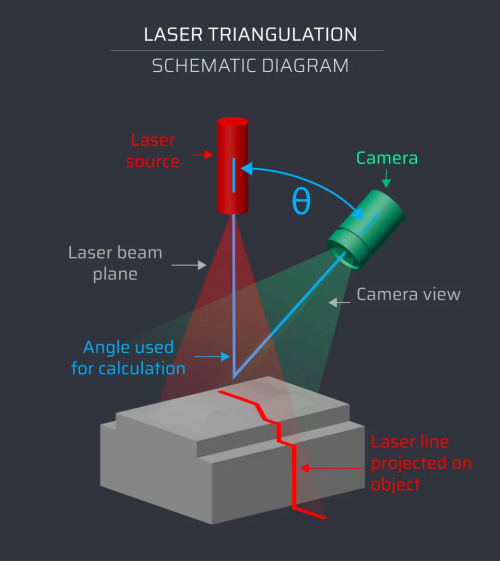
A laser 3D scanner uses one of the three measurement technologies: time of flight, phase shift, or triangulation. Time-of-flight scanners calculate the time it takes for a laser pulse to reflect back to the scanner, while phase-shift devices measure distances by comparing modulated light wave patterns. Triangulation scanners, ideal for short-range measurements, use trigonometry to determine distances by forming a triangle between the laser source, the object, and the sensor, making them suitable for capturing small to medium-sized objects.
Triangulation-based laser scanners operate by emitting laser light onto an object and capturing reflected light with an onboard camera sensor. The system calculates the distance to the object using trigonometric triangulation, forming a triangle between the laser source, the sensor, and the reflected target on the object’s surface. Typically used for short-range applications (less than 5 meters), triangulation scanners excel at capturing small to medium-sized objects, ranging from 1 cm to about 2-3 meters.
1. Single straight line laser module
2. Single-channel laser module to project Grid/ Structured dot matrix (use focus lens +DOE).
3. Single-channel laser module to project a multi-line pattern with a DOE (use focus lens +DOE).
4. Single-Channel laser module to project parallel multi-line laser beams ( use Powell line lens +DOE).
5. Multi-Channel laser module to project intersecting and parallel multi-line laser beams ( use Powell line lens +DOE). For current standard module, the customer can select to made it with one line, 3 lines, 7 lines, 13 lines, 21 lines, 25 lines, 49 lines.
All the above lasers can be customized with wavelength 375-980nm, different power, housing size, and so on. To know more, please get in touch with us at song@bu-laser.com.


